
When companies search for external expertise, one question comes up again and again: staff augmentation vs consulting. At first glance, both seem similar; they bring in outside help. But in reality, they solve very different problems.
Choosing the wrong model can lead to wasted budget, slow execution, or poor results. Choosing the right one can reduce costs, improve efficiency, and accelerate growth especially in industries like healthcare where accuracy and compliance matter most.
This guide breaks everything down in a practical, real-world way so you can make the right decision.
Quick Answer
The main difference between staff augmentation and consulting is this:
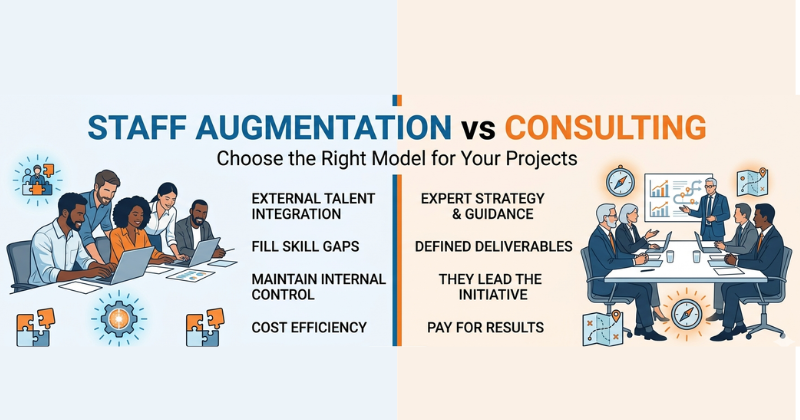
- Staff augmentation adds skilled professionals to your existing team so you can execute tasks.
- Consulting provides expert advice and strategy to solve business problems.
If you need extra hands, choose staff augmentation.
If you need expert direction, choose consulting.
What is Staff Augmentation?
Staff augmentation is a hiring model where you bring in external professionals to work under your management, just like your internal employees but without long-term commitments.
These professionals fill specific skill gaps and integrate into your workflow.
Example:
A clinic needs a medical billing expert for 4 months. Instead of hiring full-time, they use staff augmentation solutions to quickly onboard a specialist.
What is Consulting?
Consulting is when you hire external experts or firms to analyze your business, identify problems, and provide solutions. In many cases, they also help implement those solutions.
Example:
A hospital hires consultants to improve revenue cycle management and ensure compliance with healthcare regulations.
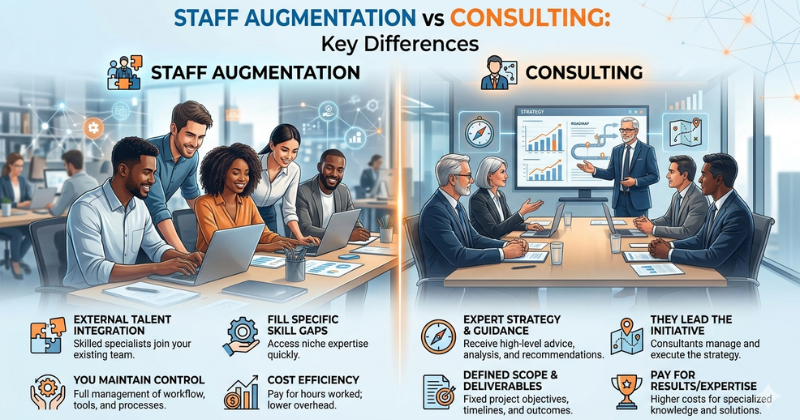
Staff Augmentation vs Consulting: Side-by-Side Comparison
| Feature | Staff Augmentation | Consulting |
| Control | You manage the team | Consultant leads |
| Purpose | Execution | Strategy & problem-solving |
| Integration | Works within your team | Works independently |
| Cost | Flexible (hourly/monthly) | Higher, project-based |
| Speed | Fast onboarding | Slower, analysis-heavy |
| Best For | Skill gaps, workload | Complex challenges |
Real-World Insight (Experience-Based)
In service-based businesses like accounting and healthcare support, one pattern is clear:
- Companies struggling with day-to-day workload benefit more from staff augmentation
- Companies facing system inefficiencies or financial leaks benefit more from consulting
For example, businesses that outsource bookkeeping tasks through staff augmentation often reduce operational costs by 20–40%, while consulting is more useful when redesigning entire financial systems.
When Should You Choose Staff Augmentation?
Choose staff augmentation when:
- You already have a system in place
- You need skilled professionals quickly
- Your team is overloaded
- You want full control over execution
Example Use Cases:
- Hiring developers for a short-term project
- Adding medical coders during peak patient load
- Scaling customer support teams
When Should You Choose Consulting?
Consulting is the better option when:
- You don’t know what the problem is
- You need expert guidance
- Your business needs transformation
- The risk of mistakes is high
Example Use Cases:
- Financial restructuring
- Process optimization
- Compliance audits
- Technology implementation
Staff Augmentation vs Consulting in Healthcare
Healthcare is one of the most complex industries, where both models are widely used—but for different reasons.
Staff Augmentation in Healthcare
Healthcare providers often face:
- Staff shortages
- Increased patient volume
- Administrative overload
Using staff augmentation consulting, they can:
- Hire temporary nurses, billing experts, or IT staff
- Maintain operational continuity
- Reduce burnout among internal teams
Practical Example:
A hospital experiencing seasonal patient spikes brings in additional billing staff to handle insurance claims efficiently.
Consulting in Healthcare
Healthcare consulting focuses on:
- Compliance (HIPAA and regulations)
- Revenue cycle optimization
- Digital transformation (EHR systems)
- Cost reduction strategies
Practical Example:
A clinic hires consultants to identify why claim rejection rates are high and fix the underlying process.
Key Statistics That Matter
- Healthcare staffing shortages are expected to continue growing globally
- Outsourcing and staff augmentation can reduce operational costs by up to 40%
- Businesses that use consulting for process improvement often see efficiency gains of 25–30%
These numbers show why both models are not just trends—they are strategic tools.
Pros and Cons
Staff Augmentation
Pros:
- Cost-effective
- Highly flexible
- Full control
- Quick hiring
Cons:
- Requires internal management
- Limited strategic input
Consulting
Pros:
- Expert-level insights
- Strong strategic direction
- Ideal for complex problems
Cons:
- Expensive
- Less control
- Not embedded in your daily operations
Which One Is Better?
There is no universal winner in staff augmentation vs consulting.
Choose Staff Augmentation if:
- You need execution
- You have internal leadership
- You want scalability
Choose Consulting if:
- You need clarity and direction
- You lack expertise
- The problem is complex
The Smart Approach: Use Both
Many modern businesses—especially in healthcare—use a hybrid model:
- Consultants identify problems and create strategy
- Augmented staff execute the plan
This approach combines:
- Expertise
- Efficiency
- Cost control
How to choose between Staff Augmentation and Consulting?
Ask yourself these 4 questions:
- Do I need strategy or execution?
- Do I have internal management capacity?
- Is my problem short-term or long-term?
- How critical is industry expertise (like healthcare compliance)?
Your answers will clearly point to the right model.
Final Thoughts
Understanding staff augmentation vs consulting is not just about definitions—it’s about making smarter business decisions.
- Staff augmentation solutions help you scale fast and stay flexible
- Consulting helps you solve deeper problems and build long-term strategy
In industries like healthcare, where precision, compliance, and efficiency are critical, the best results often come from using both together.
If your business is growing and operational pressure is increasing, the right model can save costs, improve performance, and give you a competitive edge.